Serving Summit, Stark, Portage & Medina Counties
Home » Home Gym in Your Basement
Home Gym in your Basement increases your ability to have no excuses. It has been shown that many people who have a home gym benefit from the money and time saved commuting to the gym. Wouldn’t you like to enjoy the benefits of a better workout experience? Consider adding a Home Gym to your basement remodel.
Adding a home gym provides a convenient and comfortable way to exercise without having to leave the comfort of your own home. The benefits of being able to work out in your own space are numerous, including the ability to exercise on your own schedule without worrying about gym hours or traveling to and from the gym. Additionally, a home gym allows for complete control over the environment, from the cleanliness of the equipment to the volume of the music. Setting up a home gym also provides flexibility in terms of the types of equipment and exercises you can do, as you aren’t limited by the options available at a public gym. Overall, adding a home gym to your living space is a wise investment in your health and wellbeing.
The average gym membership in NE Ohio runs $40–$80 a month. Add the drive, the wait for equipment, the parking, and the schedule that never quite fits your life — and you’re paying a lot for something that quietly stops working for you. A basement home gym solves all of it. No commute. No membership. No waiting. Just your space, your equipment, your time — right downstairs.
At Beautiful Basements, we build home gyms that are designed to perform — with the right flooring, the right ceiling height planning, the right lighting and ventilation, and the right layout for how you actually train. Not a spare room with a treadmill shoved in the corner. A real gym, built by a team that treats your home like their own.
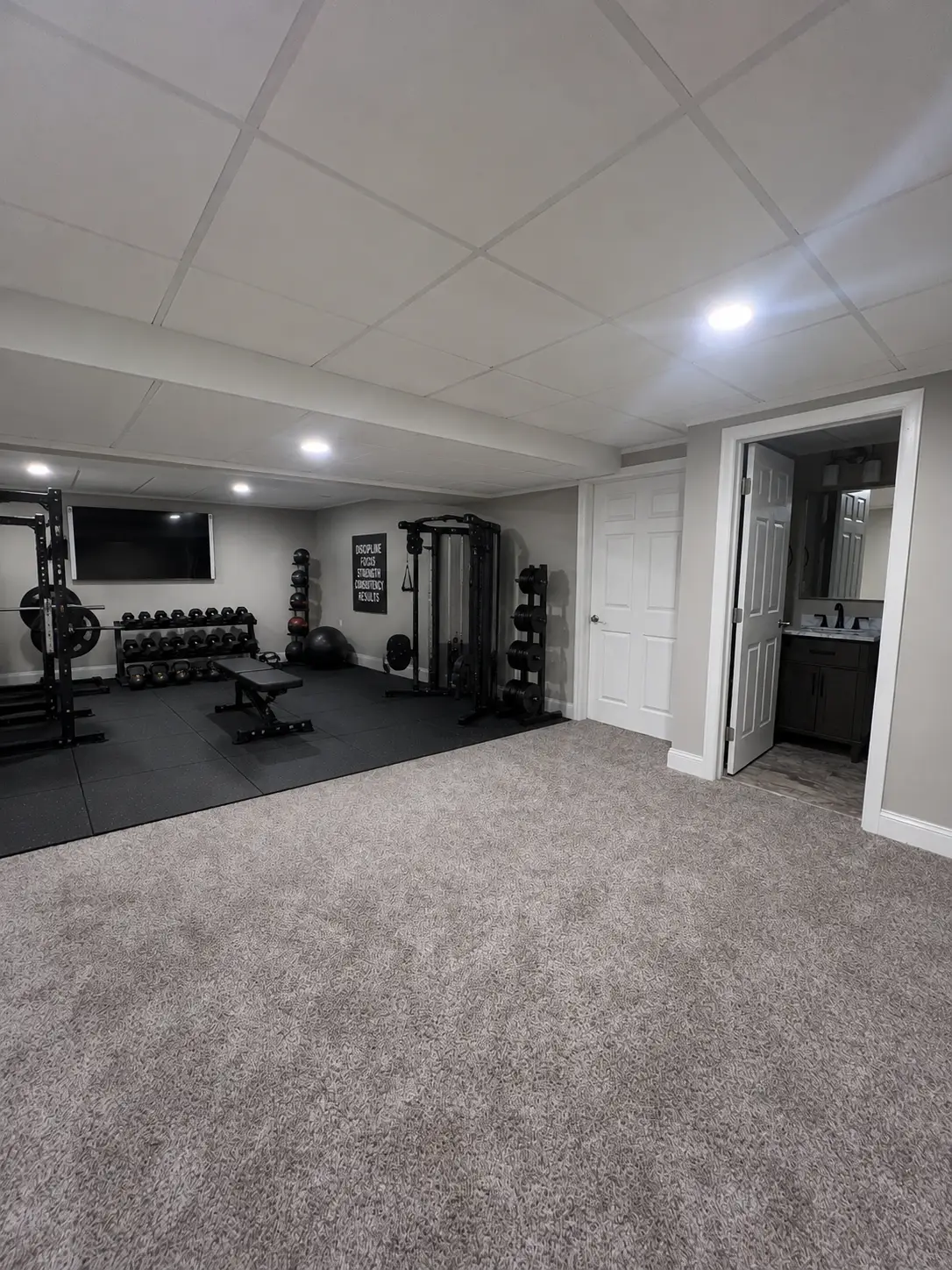
Thick rubber flooring is the single most important element in a home gym. It protects your subfloor from dropped weights, reduces noise transmission to the rest of the house, and gives you the right surface for every type of training — lifting, cardio, stretching, and more. We install it properly, with tight seams and no lifting edges..
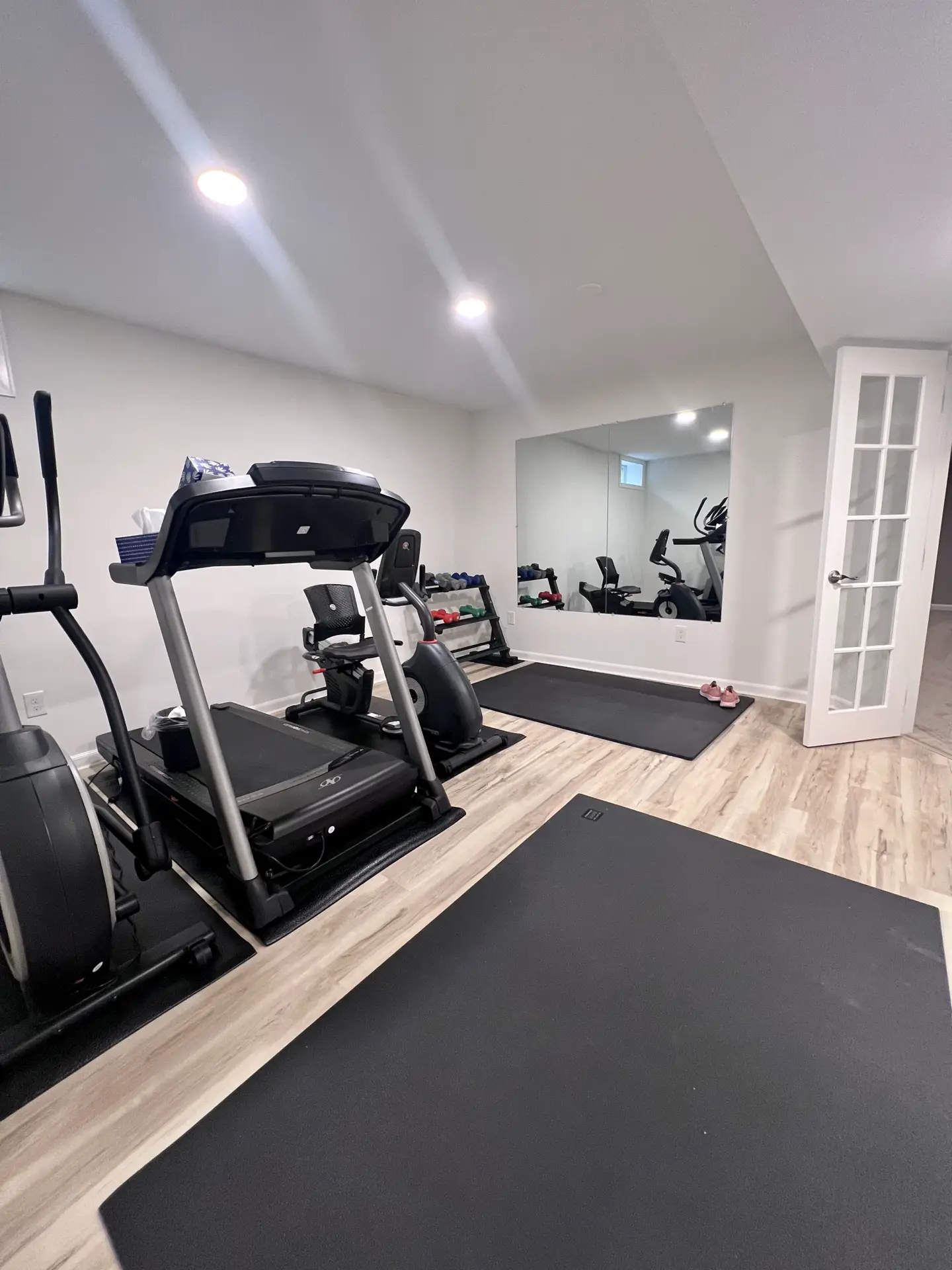
Full-length mirrors aren’t vanity — they’re a functional training tool for checking form, making the space feel larger, and keeping the room feeling like a real gym rather than a basement. We install mirror panels cleanly and securely, framed to look intentional rather than stuck on.
Dim, dingy basement lighting kills motivation before you even start. We plan bright, even overhead lighting — recessed LEDs with dimmer options — so the room is energizing and well-lit for every type of workout. Under-shelf lighting for equipment areas adds a clean, finished look.
Working out generates heat, humidity, and odor. A gym without proper ventilation becomes an unpleasant space fast. We plan exhaust ventilation and ensure your HVAC circulation reaches the gym area properly — keeping the air fresh, the temperature manageable, and the room somewhere you actually want to spend time.
Treadmills, ellipticals, TVs, sound systems, and phone charging — a gym needs dedicated circuits in the right places. We rough in electrical to where your equipment will actually live, not just the nearest wall. No extension cords running across the floor.
Ceiling height matters for overhead pressing, pull-up bars, and jump rope. We assess your basement’s clearances before framing anything and plan the layout around what your training actually requires — not just what fits. Equipment placement, traffic flow, and zone separation are all part of the design conversation.
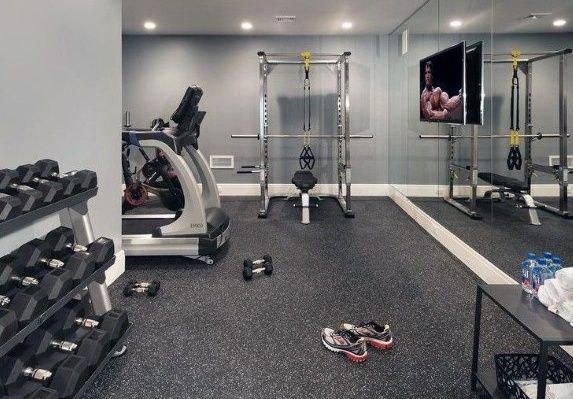
Rubber is the flooring of choice at most gyms, so it may be the best option for a home gym. It can prevent slips and falls while also absorbing impact, ideal for high-impact cardio workouts or working out with free weights. Rubber flooring won’t dent, scratch, or gouge as foam or hardwood flooring might
A gym that’s built wrong is a gym you stop using. Flooring that lifts at the seams, lighting that flickers, ventilation that was never planned — these are the things that turn a great idea into an abandoned room. Dan started Beautiful Basements to do the work right, every time, on every project. A home gym is no exception.

A gym that’s built wrong is a gym you stop using. Flooring that lifts at the seams, lighting that flickers, ventilation that was never planned — these are the things that turn a great idea into an abandoned room. Dan started Beautiful Basements to do the work right, every time, on every project. A home gym is no exception.
Rubber flooring installation, mirror mounting, and electrical work are done cleanly and carefully. We protect the rest of your home while we work and leave the space ready to use — not ready for cleanup.
How do you train? What equipment are you bringing? Do you plan to add more? We design the gym around your actual needs — not a generic template. The layout, electrical, and flooring decisions all depend on how you'll use the space.
We show up on schedule, work efficiently, and get you into your new gym as quickly as the work allows — without cutting corners to get there.
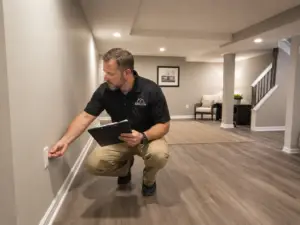
We walk the finished gym with you before we consider the job complete. Every seam, every mirror panel, every outlet in the right place. It's your gym — it should be exactly right.
A dedicated basement bathroom can bring significant value and convenience to your home in multiple ways:
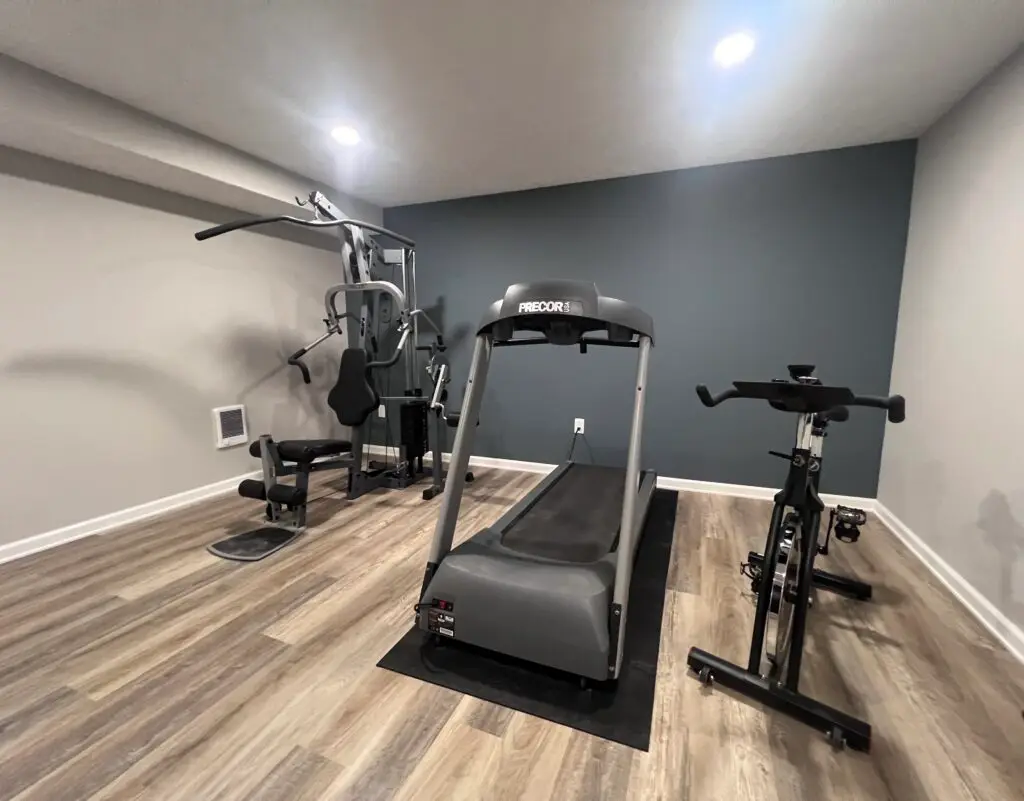
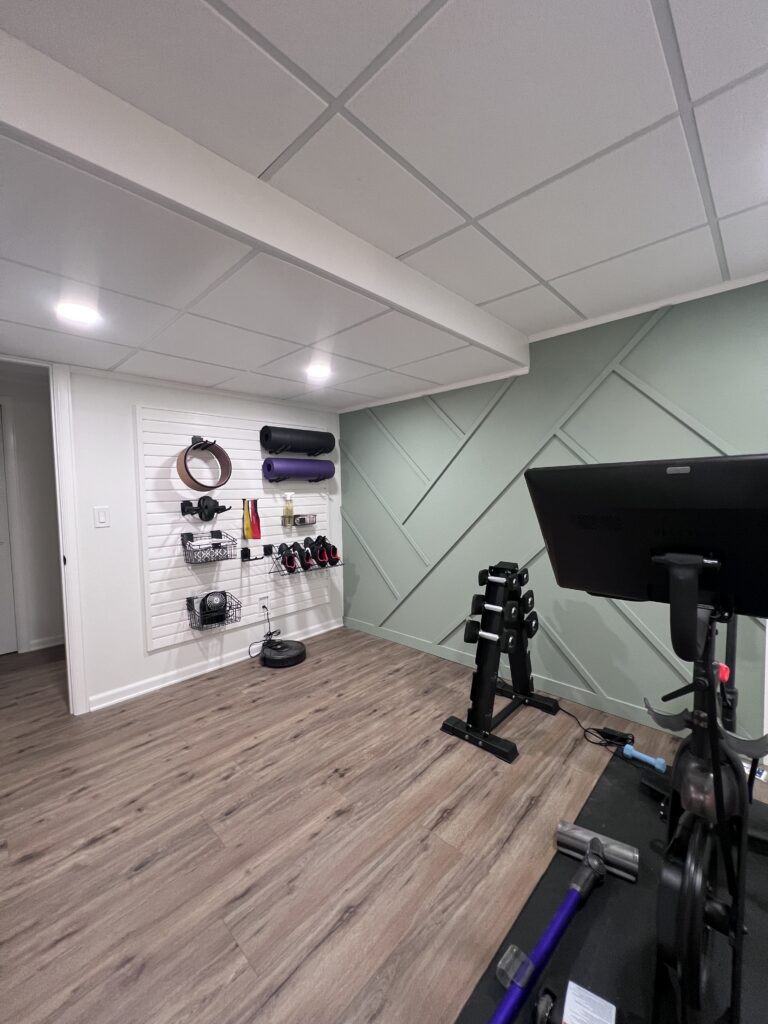
Every trainer, coach, and fitness researcher agrees on one thing: the gym you actually use is the one that’s easiest to get to. When your gym is 30 seconds away — down the stairs, any time of day or night, in any weather — the excuses evaporate. No packing a bag. No driving in an Ohio January. No waiting for a machine. You just go.
A $600-a-year gym membership for two people is $6,000 over a decade — before gas, protein shakes bought on the way home, or the months you paid but barely went. A properly built basement gym is a one-time investment that adds value to your home, eliminates that recurring expense, and is available to every member of your household every single day.
No waiting for the squat rack. No wiping down someone else’s sweat. No gym hours that close before you get off work. A home gym is available at 5am, at 11pm, on holidays, and during every Ohio snowstorm that closes the roads. You build it around the equipment you actually use — not a room full of machines you don’t.
Most NE Ohio basements are used as storage — boxes, holiday decorations, things that haven’t been touched in years. Converting even part of that space into a gym that you use four or five times a week is one of the highest-impact ways to change how you feel about your home and your daily routine. The space was already there. We just make it work for you.
A home gym isn’t just for the person who bought the treadmill. A well-designed space works for morning cardio, after-school workouts, yoga sessions, and weekend lifting. When the gym is in your home, fitness becomes a family habit — not a solo errand. We design layouts that accommodate multiple users and multiple types of training, not just one person’s routine.
Naturally cooler temperatures, separation from the main living areas, concrete subfloor that handles heavy equipment without a second thought — basements were practically designed for home gyms. The noise stays downstairs. The weights stay downstairs. And when you’re done, you’re already home. It just makes sense.
Gym flooring is not optional, and the floor you choose needs to match how you train. A yoga-and-treadmill gym has completely different flooring needs than a powerlifting gym. Most basements end up somewhere in between, which means a layered approach often makes the most sense.
Thick rubber flooring — typically 3/8″ to 3/4″ rubber tiles or roll-out rubber matting — is the workhorse of the home gym world. It does several things well at once:
For a general-purpose gym, 3/8″ interlocking rubber tiles covering the entire floor is a solid baseline. For a dedicated lifting area — especially if you’re doing any kind of Olympic lifting or dropping weight from height — 3/4″ rubber or a thicker lifting platform is worth the investment.
What rubber flooring doesn’t do well: it’s not the most comfortable surface for floor work, yoga, or stretching. If you have a dedicated yoga or mobility corner, a thinner foam mat or puzzle tile in that zone gives you a softer surface without compromising the rest of the floor.
In many basement gym builds, we install LVP (luxury vinyl plank) as the base floor and rubber on top in the workout zone. This works well when the gym shares space with a multi-use area — a rec room, a family hangout space, a bar. The LVP gives the non-gym areas a finished, residential look, and the rubber tiles define the workout zone and can be reconfigured if your training evolves.
If the entire room is dedicated gym space, rubber directly on the concrete is more efficient and equally effective.
Standard carpet is the wrong call for a gym. It compresses under equipment, traps sweat and odor, and creates an unstable surface for lifting. If you’re inheriting carpet in a basement you’re converting to a gym, remove it.
Smooth hard tile creates slip hazards under workout conditions and has zero shock absorption. Keep it out of the workout zone.
Thin foam puzzle tiles — the brightly colored interlocking kind — are fine for a children’s play area or a yoga-only space, but they’re not durable enough for equipment, heavy foot traffic, or any kind of impact loading. They compress and degrade quickly under real gym use.
Ceiling height is the variable that most limits what a basement gym can do. It’s worth being honest about your space before you fall in love with equipment that won’t work in it.
Here’s a practical guide to what ceiling height you actually need:
For a basement gym, a dropped ceiling is often the better choice — not for aesthetic reasons, but for access. A gym puts more stress on a space than almost any other basement use: vibration from treadmills, impact from dropped weights, humidity from exertion. You want to be able to get to plumbing and electrical without tearing out drywall if something needs attention.
A drywall ceiling is appropriate when you have the ceiling height to spare, you want a cleaner finish, and your mechanicals can be routed above the finished plane or boxed in attractively.
The hybrid approach works well in larger gyms: drywall in the main workout area (cleaner look, better acoustic performance) with a drop tile or open-ceiling section over the mechanical chase. We’ll work through what makes sense for your specific space during the planning conversation.
Some homeowners opt for an exposed ceiling — painted joists, visible ductwork, industrial look. This is aesthetically fine and maximizes ceiling height, but it requires planning: exposed ductwork and wiring needs to look intentional, not abandoned. Paint everything the same color (black or dark gray typically reads best), tuck wiring neatly, and the look can work well for a gym environment.
One practical note: exposed ceilings collect dust and are harder to clean in a high-exertion space. Factor that into maintenance expectations.
Whatever ceiling treatment you choose, gym lighting deserves specific attention. You need:
The best gym layout is the one that matches your actual training — not an idealized version of every piece of equipment you might someday own. Start with what you do most, design around that, and leave room for the next thing.
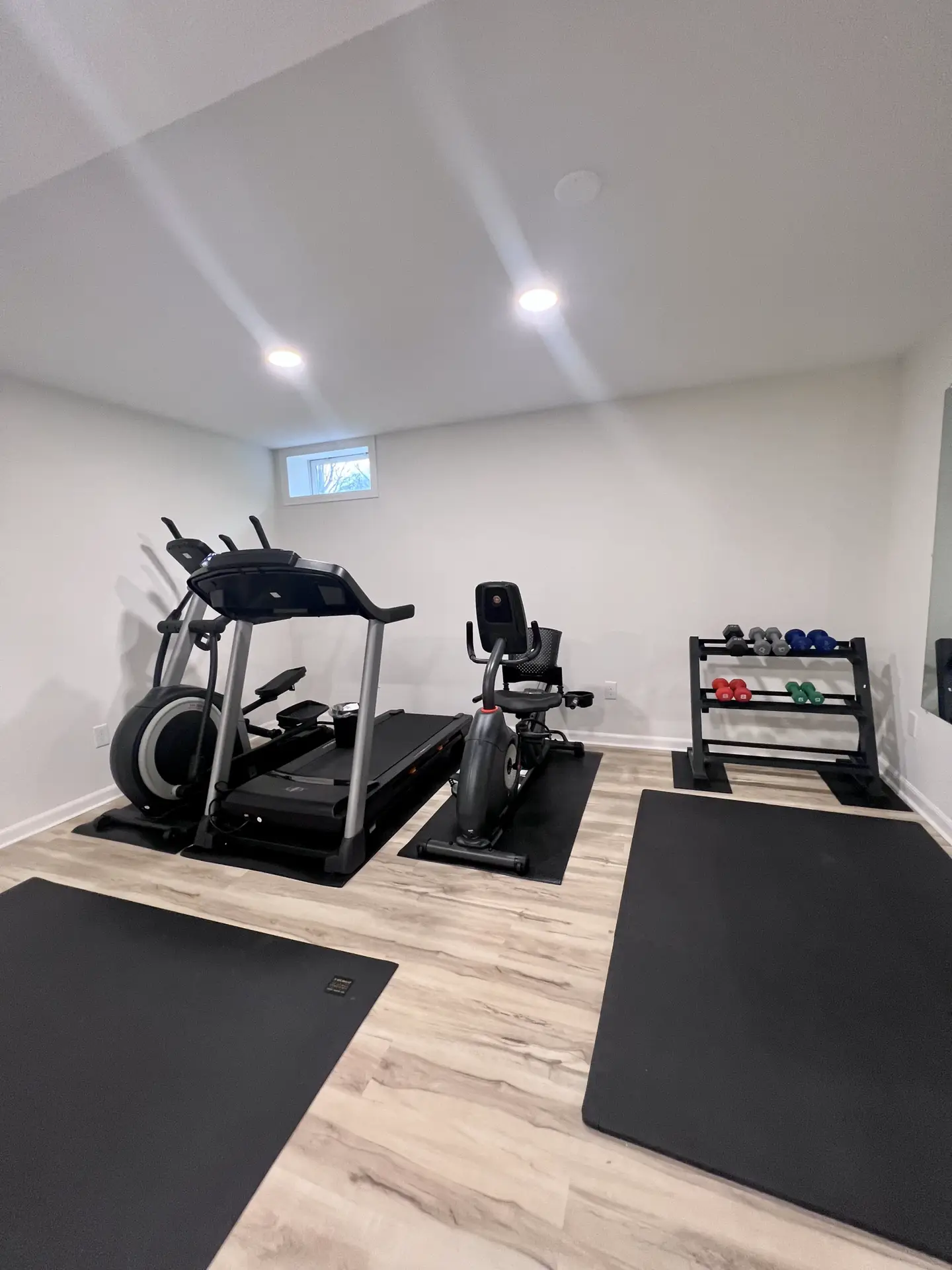
Most home gyms benefit from separating activities into zones even in a modest-sized space:
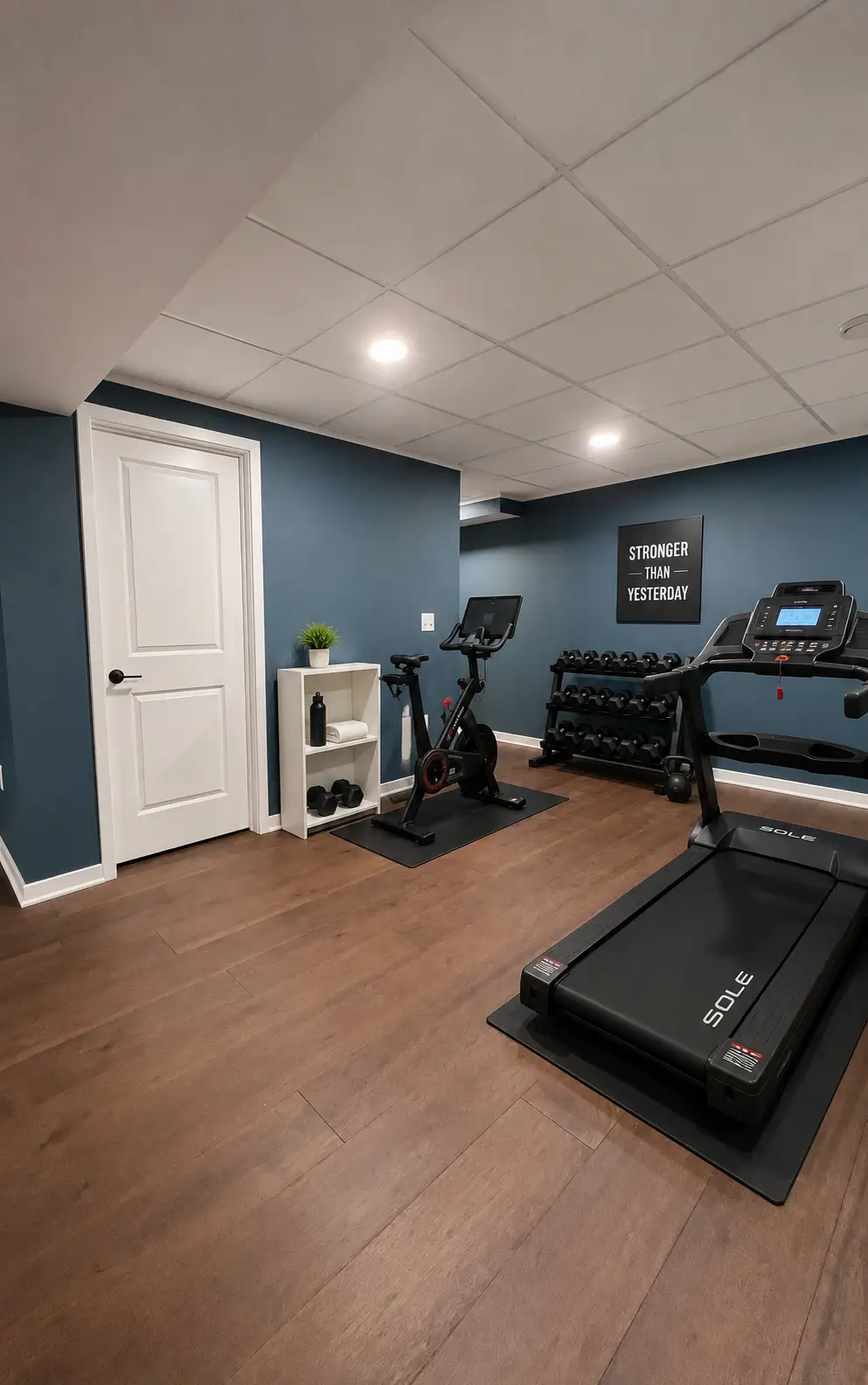
Cardio zone — treadmills, bikes, rowers, and ellipticals. These are typically the largest footprint items and produce the most vibration. Position them away from load-bearing walls and consider rubber isolation pads under motorized equipment to reduce vibration transfer. If you watch TV or a screen during cardio, this zone needs a sightline to the display and wiring to match.
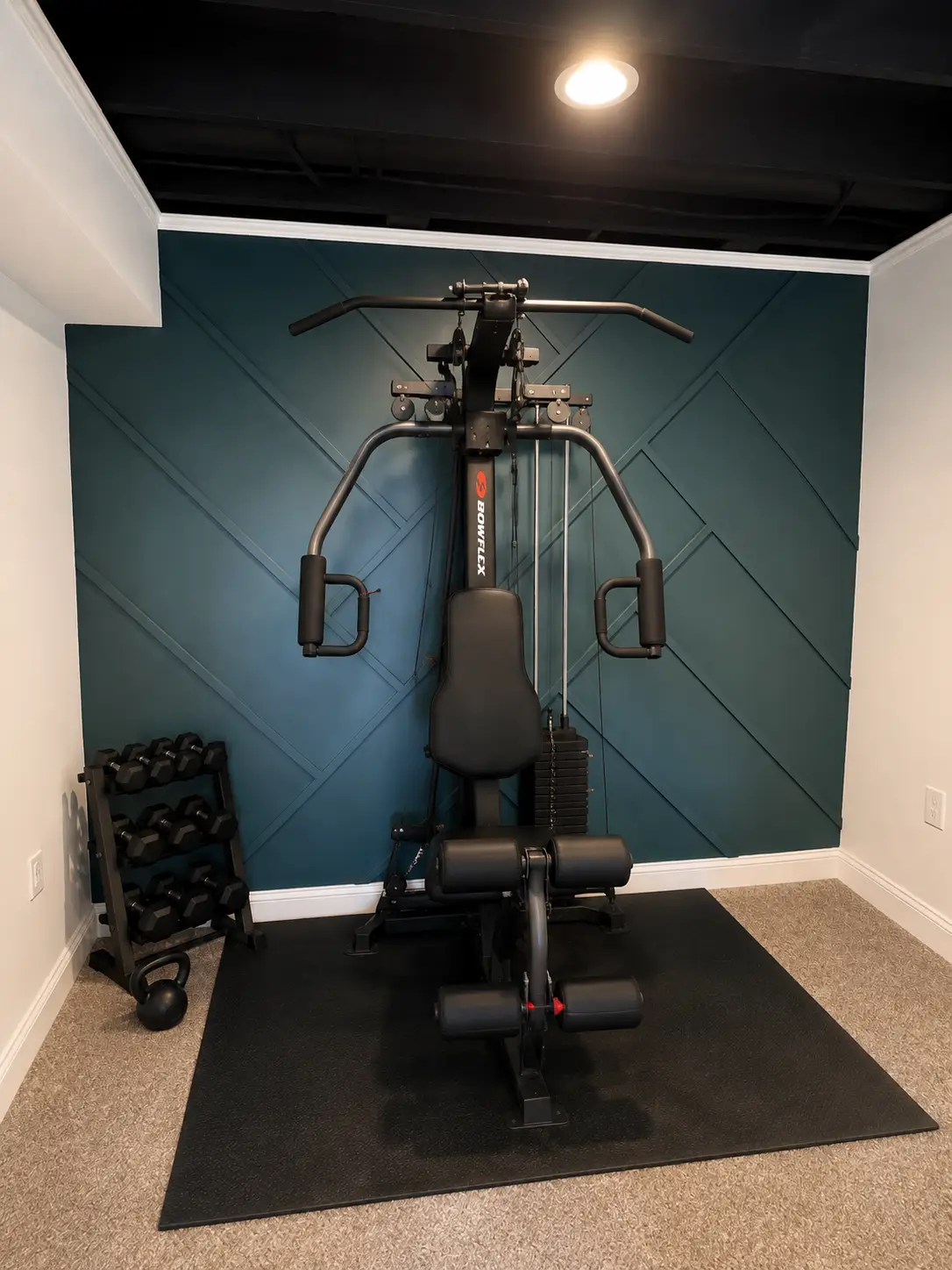
Free weight zone — dumbbells, barbells, benches, and racks. This is the highest-impact zone: dumbbells get dropped, weight plates get stacked and restacked, and the floor takes a beating. Thicker rubber flooring here is non-negotiable. A dedicated lifting platform under the rack adds another layer of protection and keeps the lifting zone clearly defined.
Functional / floor work zone — stretching, mobility, yoga, bodyweight work. This needs clear floor space and softer underfoot material. It’s often the zone that gets squeezed out in layout planning, but having dedicated open floor space is what separates a home gym from a room full of equipment.
Every piece of equipment needs at least 3 feet of clearance on the sides and back for safe use. A squat rack needs room to load plates from both sides. A treadmill needs room to step off the sides safely. A cable machine needs room to move through the full range of motion without hitting a wall.
Map your equipment footprints with clearance before anything gets ordered. Many home gym layouts fail because equipment is too close together or too close to walls, and the room becomes unsafe or unusable at full capacity.
A mirrored wall — typically floor-to-ceiling on one long wall — makes a home gym feel significantly larger and serves a real functional purpose for form checking. Position it facing your primary lifting area. If your ceiling height is limited, running mirrors to the ceiling line makes the room feel taller than it is.
Equipment that doesn’t have a designated home doesn’t get put away. Plan for:
A gym that stays organized is a gym that gets used. A gym that becomes a place to pile stuff is a gym that stops getting used.
You’re going to sweat in here. A lot. Gym ventilation is not a nice-to-have — it’s essential.
A dedicated HVAC supply and return keeps air moving and prevents the room from becoming a stale, humid box after a single workout. This is worth discussing as part of the mechanical plan before the room is closed up.
Temperature in the mid-60s°F is ideal for most training — cool enough to keep your core temperature from climbing too fast. Basements naturally run cool, which helps. In the winter, make sure the supply is adequate to keep the space above 60°F during warm-up. Cold muscles and cold rubber flooring do not combine well.
Humidity is worth managing. A high-humidity gym is uncomfortable, damages equipment faster, and creates conditions for mold. A properly sealed and conditioned basement stays in a reasonable range, but if your basement has any history of moisture, address it before the gym goes in — not after.
A display in a home gym is almost universally worth it. Whether it’s streaming workout content, watching game film, or just having something to look at during cardio, a mounted TV or monitor makes the space more usable.
Plan your TV location during layout — not as an afterthought. That means wiring the outlet and low-voltage conduit behind the wall before drywall goes up, choosing a mounting height that works for both seated cardio and standing positions, and making sure the display is visible from the cardio zone without straining.
We build the room: framing, insulation, ceiling, lighting, electrical, and all finish work including flooring. Our licensed electrical partners handle every circuit, outlet, and in-wall conduit run. We’ll coordinate placement for your TV mount, ensure you have dedicated circuits for motorized equipment, and build to the structural standards a gym demands — not just the finish standards.
We don’t supply gym equipment, but we’ll plan around it. Bring your equipment list to the consultation and we’ll design the layout, ceiling height, and electrical plan around what you’re actually going to use.
A basement home gym is one of the highest-ROI projects we do — high daily use, no ongoing costs, and a real impact on how you live in your house. If you’re in Summit, Medina, Stark, or Portage County, let’s talk through what your basement can support.
If you’re considering finishing your basement, you likely have a lot of questions about the process. Whether you’re looking to create an extra living space, a home gym, or a media room, remodeling your basement can add value to your home and increase your living space. To help you get started on your basement renovation project, we’ve compiled a list of the top ten questions and answers people often have when researching basement finishing.
For most home gyms, thick rubber flooring — typically 3/8″ to 3/4″ depending on the type of training — is the right choice. It absorbs impact from dropped weights, reduces sound transmission to upstairs living areas, and holds up to years of heavy use without cracking, peeling, or compressing. For yoga or stretching zones, foam tiles or a padded LVP area can be incorporated. We’ll help you choose based on how you plan to use the space — there’s no single right answer for every gym.
Most NE Ohio basements have 7–8 feet of ceiling height, which is workable for the majority of gym setups — cardio equipment, free weights, machines, and floor work. Overhead pressing, pull-up rigs, and jump rope benefit from 8 feet or more. We assess your specific ceiling height and ductwork situation during the estimate and tell you honestly what’s possible. In some cases, we can adjust how mechanicals are routed to gain additional clearance.
Thick rubber flooring is your first and most effective line of defense — it absorbs the impact of dropped weights and dramatically reduces the thud that travels through the floor. Insulation in the ceiling framing helps with airborne noise like music and equipment hum. For serious Olympic lifting or very heavy drops, we can discuss additional acoustic isolation options during the estimate. Most homeowners find that proper rubber flooring alone handles 90% of the noise concern.
A finished basement adds value regardless of how it’s configured — and a home gym is one of the most appealing configurations for today’s buyers in NE Ohio. Post-pandemic, dedicated fitness spaces at home rank consistently high on buyer wish lists. A well-built basement gym signals that the lower level is genuinely finished and thoughtfully designed, which increases both appraised value and buyer interest at resale.
click to see this service
click to see this service
click to see this service
click to see this service
click to see this service
Click to see this service









A basement home gym is one of the most practical investments a homeowner can make. No commute, no waiting for equipment, no membership fees — just a space designed around how you actually want to train. Done right, it’s a room you’ll use every day. Done wrong, it’s an expensive storage area with a treadmill in the corner. The difference comes down to three things most people underestimate before they start: flooring, ceilings, and layout. Get those right, and the equipment decisions are easy. Get them wrong, and no amount of nice equipment fixes the room. Here’s what you need to know.
Get the ultimate guide to Basement Finishing in Northeast Ohio.