If you’ve gotten a quote from multiple basement finishing companies, you may have noticed something: not everyone builds the same way. One of the biggest differences — and one most homeowners don’t think to ask about — is what’s holding up your walls.
At Beautiful Basements, we frame every basement with steel studs. Here’s why that decision matters more than you might think.
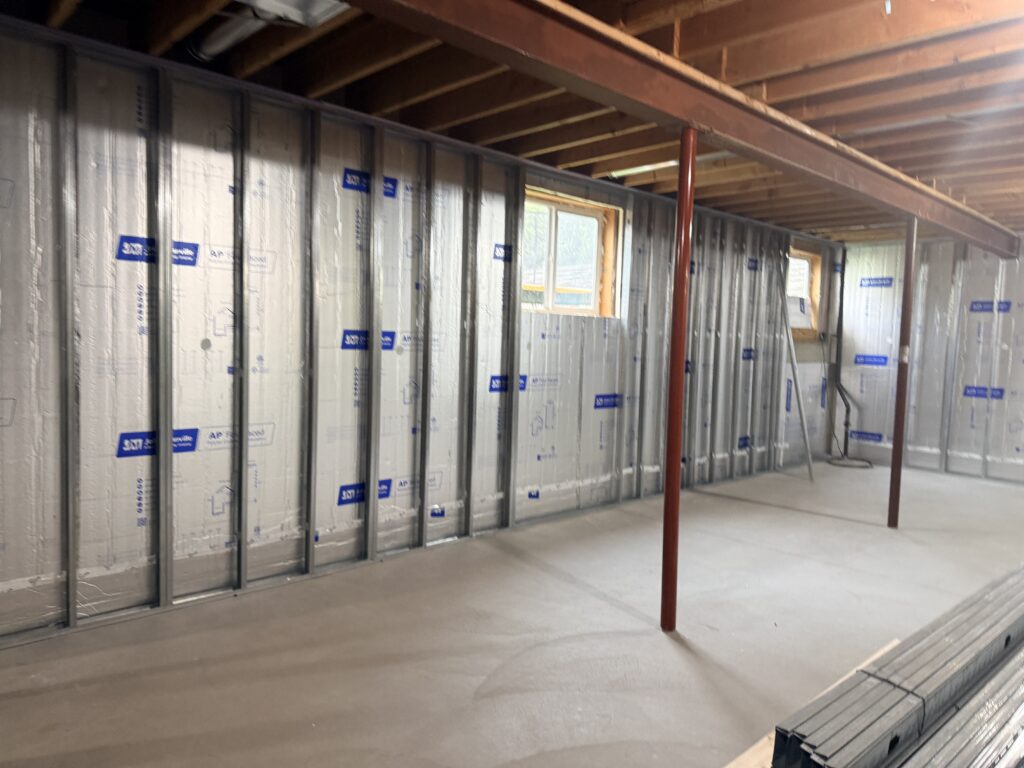
Wood vs. Steel: What’s the Real Difference?
Wood framing is the default in most above-grade construction, and it works great — up there. But a basement is a different environment entirely. Even a well-waterproofed basement sees higher humidity, minor moisture fluctuations, and temperature swings that wood simply doesn’t handle as well over time.
Steel studs don’t warp. They don’t swell. They don’t rot. And critically — they don’t become a food source for mold.
That last point is worth sitting with. Mold needs three things to grow: moisture, warmth, and organic material. Wood is organic. Steel is not. In a below-grade space where moisture is always a factor (no matter how good your waterproofing), removing the organic material from your wall framing is a meaningful layer of protection.
Steel Studs Are Straighter — Which Means Flatter Walls
Here’s something finish carpenters and drywall crews know well: wood studs come from a lumber yard in varying degrees of straightness. Some are fine. Some are bowed, twisted, or cupped. Getting a perfectly flat wall with inconsistent wood studs takes extra time and skill.
Steel studs are manufactured to consistent dimensions. They don’t warp on the truck or sitting in the garage overnight. That means straighter walls, tighter fits, and a cleaner finished look — the kind of look you notice when the room is done.
They Won’t Shrink and Crack Your Drywall
One of the sneakiest causes of drywall nail pops and hairline cracks in finished spaces is wood movement. Wood expands and contracts with humidity and temperature changes. Over a few years, this can stress drywall seams and fasteners, leading to visible cracks that need patching.
Steel doesn’t move like that. Once it’s up, it stays put — which means the drywall stays smooth and the finish stays clean, year after year.
It’s the Right Material for the Right Environment
There’s a reason commercial construction — offices, hospitals, schools — uses steel stud framing almost exclusively for interior walls. It’s durable, dimensionally stable, and designed to last. We think your basement deserves the same standard.
A finished basement is a significant investment. Using inferior materials to save a few dollars on framing doesn’t make sense when you consider the life of the space. We’d rather build it right the first time than have you dealing with problems down the road.
What This Means for You
When you finish your basement with Beautiful Basements, you get:
- Steel stud framing throughout, designed for below-grade environments
- Walls that stay straight and flat over the long term
- One less foothold for mold in a space where moisture is always a consideration
- The peace of mind that comes from knowing your basement was built the way it should be
Thinking about finishing your basement in Summit, Medina, Stark, or Portage County? Get a free estimate from Beautiful Basements and see what building it right actually looks like.